
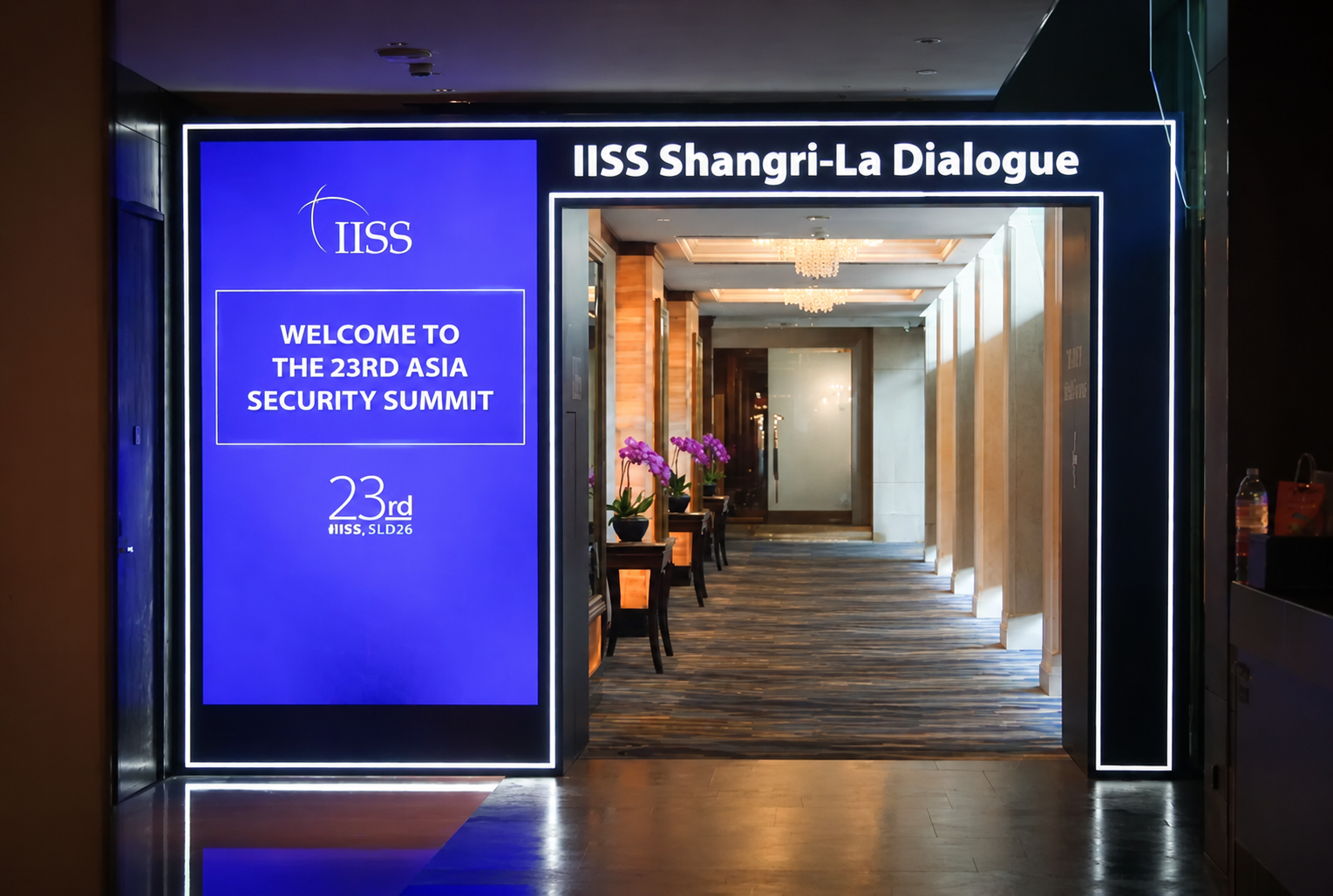
The 2026 Shangri-La Dialogue, held in Singapore from 29-31 May, convened defence ministers, military leaders, and strategic experts from across the Indo-Pacific at a time of profound geopolitical uncertainty. Against the backdrop of intensifying great-power competition, ongoing conflicts in Europe and the Middle East, and growing concerns over regional security architecture, this year’s dialogue offered important insights into the evolving balance of power in Asia.
Unlike previous years, the most striking feature of the 2026 Dialogue was not what was said, but who was absent. China’s Defence Minister Dong Jun did not attend for the second consecutive year, sending instead a delegation from the People’s Liberation Army National Defence University. This decision became a central topic of discussion throughout the conference and reflected broader changes in regional strategic dynamics.
The United States Signals Continued Commitment – With Conditions
U.S. Defense Secretary Pete Hegseth reaffirmed Washington’s commitment to maintaining a strong military presence in the Indo-Pacific and preventing any single power from achieving regional dominance. However, his message differed from previous administrations in one significant respect: allies are expected to assume greater responsibility for their own defence.
Throughout his address, Hegseth repeatedly emphasized burden-sharing, encouraging Asian partners to increase defence spending and contribute more actively to regional deterrence. While reaffirming America’s strategic presence, Washington also signaled that future security cooperation would increasingly depend on reciprocal commitments from allies.
This reflects a broader evolution in U.S. strategy. Rather than acting as the sole guarantor of regional stability, the United States appears to be encouraging a more distributed security architecture in which regional partners play a greater role.
China’s Absence Becomes a Strategic Message
The absence of China’s defence minister was widely interpreted as a deliberate political decision rather than a scheduling issue. For over a decade, the Shangri-La Dialogue served as one of the few venues where senior Chinese and American defence officials publicly exchanged views and engaged in direct diplomacy. Beijing’s decision to downgrade its representation for a second consecutive year suggests growing skepticism toward multilateral security forums perceived as being dominated by Western narratives.
However, China’s absence should not be interpreted as strategic retreat. Beijing continues to expand bilateral security engagement, military diplomacy, and defence cooperation through alternative platforms and regional mechanisms. The issue is therefore less about disengagement and more about competing visions of regional order.
The result is an increasingly fragmented diplomatic landscape where major powers are choosing different forums through which to exercise influence.
The Rise of Middle Powers
Perhaps the most important long-term development highlighted by the Dialogue was the growing role of middle powers.
Japan, Australia, Vietnam, the Philippines, and several ASEAN states increasingly demonstrated their willingness to shape regional security outcomes rather than merely react to great-power competition.
Vietnamese leader To Lam’s keynote speech emphasized the importance of international law, trust-building, and inclusive security cooperation. Meanwhile, Japan continued to present itself as a more active security provider, expanding defence cooperation and security partnerships across Southeast Asia.
This trend reflects a broader transformation of the Indo-Pacific. Regional states are no longer passive participants in a U.S.-China rivalry. Instead, they are seeking strategic autonomy while simultaneously strengthening partnerships with multiple actors.
Maritime Security and Economic Security Converge
Another recurring theme throughout the conference was the growing interconnection between economic resilience and national security.
Discussions increasingly focused on supply chains, critical infrastructure, undersea cables, maritime trade routes, and technological competition. The Strait of Hormuz crisis earlier this year reinforced concerns that disruptions in one region can rapidly affect global economic stability.
As a result, defence planning is becoming more closely linked with economic security policy. Future regional competition will likely extend beyond traditional military capabilities to include industrial resilience, technology governance, and strategic supply chains.
Assessment: What Does Shangri-La 2026 Tell Us?
Three conclusions emerge from this year’s Dialogue.
First, the Indo-Pacific security order is becoming more decentralized. While the United States remains the region’s leading military power, allies and partners are expected to assume greater responsibility for regional security.
Second, China is increasingly pursuing a parallel diplomatic strategy. Rather than withdrawing from regional affairs, Beijing appears to be selectively engaging in forums that better align with its strategic preferences.
Third, middle powers are becoming indispensable actors. Countries such as Japan, Australia, Vietnam, and Singapore are no longer merely balancing between Washington and Beijing; they are actively shaping the future regional order.
The traditional image of an Indo-Pacific dominated exclusively by U.S.-China competition is gradually giving way to a more complex and multipolar security environment.
Looking Ahead
Looking forward, three developments deserve close attention.
- Whether Washington can maintain regional confidence while simultaneously demanding greater burden-sharing from allies.
- Whether Beijing returns to higher-level participation in regional security dialogues or continues to rely on alternative diplomatic mechanisms.
- Whether ASEAN and other middle powers can preserve strategic autonomy amid increasing pressure from competing major powers.
The 2026 Shangri-La Dialogue demonstrated that the future of Indo-Pacific security will not be determined solely by the actions of Washington or Beijing. Instead, it will be shaped by a growing network of regional actors seeking to build a more resilient, flexible, and multipolar security order.
The emerging Indo-Pacific is no longer a bipolar contest-it is becoming a strategically crowded and increasingly decentralized geopolitical landscape.