
- EXECUTIVE SUMMARY: THE WEAPONIZATION OF NON-KINETIC FORCE
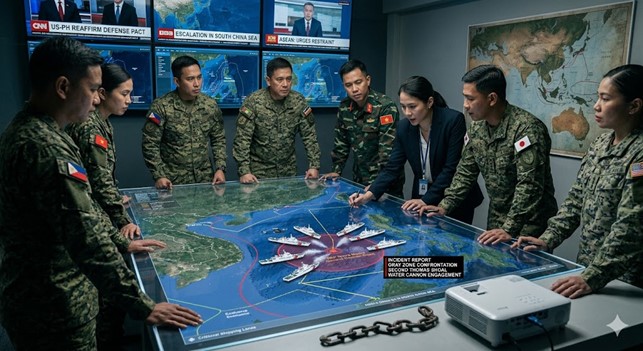
The recent incidents at Second Thomas Shoal, as documented in the latest BBC field reports, represent a sophisticated evolution of the “Grey Zone” strategy. We assess that these maneuvers are no longer mere territorial frictions but are calculated Brinkmanship Tests designed to probe the activation thresholds of the U.S.-Philippines Mutual Defense Treaty (MDT).
- Physicalized Legal Warfare: By utilizing the China Coast Guard (CCG) for water cannon deployments and physical blockades, Beijing is effectively “weaponizing” law enforcement. This strategy allows the PRC to exert Administrative Control over contested waters while remaining below the threshold of “armed attack,” thereby neutralizing traditional military deterrence.
- The Strategy of Attrition: Through a sustained blockade of resupply missions, Beijing is engaging in a contest of strategic patience. The goal is to force a unilateral Philippine withdrawal from the BRP Sierra Madre by making the logistical and political costs of maintenance unsustainable.
- THE DETERRENCE PARADOX: DILUTION OF EXTENDED DETERRENCE
This escalation exposes a “functional fissure” in the current Indo-Pacific security architecture:
- The Ambiguity Gap: While Washington has reaffirmed that the MDT covers the South China Sea, the proportional response to a “water cannon” versus a “missile strike” remains undefined. This ambiguity provides an exploitable strategic space for challengers to alter the status quo without triggering a full-scale kinetic response.
- Cognitive Warfare and Transparency: The Marcos administration’s policy of “radical transparency”inviting international press like the BBC to document these encounters—serves as a potent counter-measure. This is a form of Information Warfare designed to raise the reputational and diplomatic costs for Beijing on the global stage.
III. STRUCTURAL SPILLOVERS: FROM ASEAN CENTRALITY TO “LATTICE-LIKE” ALLIANCES
The heat in the South China Sea is accelerating a paradigm shift in regional power structures:
- The Marginalization of ASEAN: The BBC reports underscore a cold reality: multilateral mechanisms, such as the Code of Conduct (COC) negotiations, are largely paralyzed in the face of high-intensity territorial conflict. The initiative for regional security is shifting toward Minilateralism.
- Horizontal Interconnectivity: To mitigate the risks of sole reliance on the U.S., Manila is rapidly building horizontal security links with Japan, Australia, and Vietnam. This “Lattice-like” alliance structure—defined by horizontal cooperation between non-superpower allies—is becoming the most resilient feature of the new Indo-Pacific order.
- POLICY IMPLICATIONS AND PROJECTION
- Redefining Aggression: The international community must reach a new legal consensus regarding “coordinated non-kinetic assaults” to prevent grey-zone actions from eroding the foundations of international maritime law.
- Coast Guard Integration: We recommend that allied cooperation (US-Japan-Australia-Philippines) expand beyond traditional naval exercises into Joint Coast Guard Patrols and integrated maritime domain awareness (MDA) sharing.
- Economic-Security Linkage: Freedom of navigation in the South China Sea is inseparable from global supply chain security. Economic diplomacy must integrate “maritime lane security” into the core articles of regional trade agreements.
CONCLUSION
The 2026 confrontations at Second Thomas Shoal are a direct collision between Westphalian Sovereignty and Post-Modern Maritime Hegemony. For Manila, this is a battle for sovereign integrity; for Washington and Beijing, it is a long-term contest over the rule-making authority in the Indo-Pacific. If the liberal order fails to find effective counters to grey-zone maneuvers, the bedrock of regional security will face irreversible erosion.