
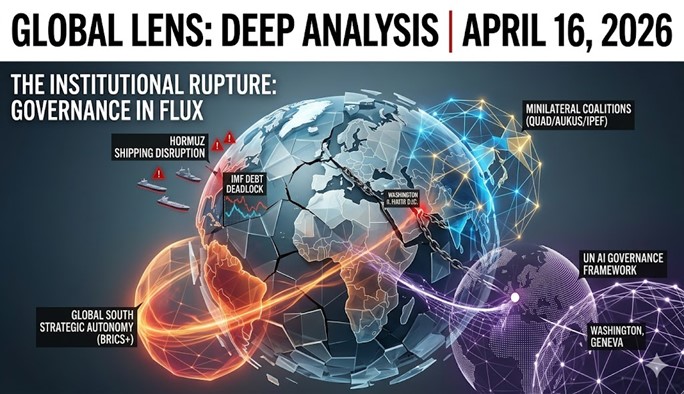
This commentary examines April 16, 2026, as a symbolic turning point in global governance. Through developments in maritime security, sovereign debt negotiations, and AI regulation, it argues that the post-war institutional order is entering an era of systemic fragmentation. The article explores how emerging minilateral coalitions, financial realignment, and technological competition are redefining the rules of international politics.
If 2024 was the “Year of Elections” and 2025 the “Year of Confrontation,” then today, April 16, 2026, marks the moment the global governance structure entered a period of “Systemic Fracturing.” Today’s headlines—ranging from the naval blockades in the Strait of Hormuz to the debt deadlock at the IMF Spring Meetings—collectively signal the twilight of the post-WWII order and the chaotic dawn of a new, fragmented set of rules.
- The “Minilateralization” of Security: From the UN to Strategic Inner Circles
Today’s escalation in the Strait of Hormuz has officially exposed the paralysis of the UN Security Council in protecting the world’s most vital maritime arteries.
- The Reality of Governance: As UN resolutions remain stalled by Great Power vetoes, real security governance has shifted to “ad-hoc coalitions.” Today’s news reports that the “Maritime Assurance Initiative,” comprised of the UK, US, Japan, and regional partners, has effectively bypassed UN peacekeeping logic.
- Analysis: We are witnessing the “Privatization of Security.” Future global governance will no longer pursue “universal security” but rather “aligned security.” While this minilateralism is tactically efficient, it means the high seas will be carved into “safe zones” for allies, signaling the end of low-cost, frictionless global logistics.
- The “Southward Shift” of Financial Governance: Debt as Geopolitical Leverage
At the IMF and World Bank Spring Meetings in Washington today, the conversation has pivoted from fiscal deficits to “Sovereign Debt Restructuring” as a theater of power politics.
- Point of Conflict: The Western-led “Global Sovereign Debt Roundtable” remains deadlocked due to diverging lending standards with emerging economies. Today, the “Global South” bloc issued a collective statement demanding that climate-related debt relief be legally decoupled from traditional financial obligations.
- Trend Analysis: Finance is becoming the new battlefield. We are seeing the rise of “Strategic Default and Restructuring” as a diplomatic tool. Developing nations are utilizing the friction between Western and non-Western financial systems to negotiate better terms. This suggests that the next decade will not be dominated by the “Washington Consensus,” but by a dual-track or multi-track global financial architecture.
- The Final Window for Tech Governance: The AI Arms Race vs. The Rulebook
The UN’s launch of the Global Dialogue on AI Governance in Geneva today is, in essence, a “race against the clock.”
- The Urgency: Reports surfaced today of AI-driven swarm drones with autonomous “kill-chain” decision-making being deployed in regional conflicts. This has instantly shifted AI governance from “ethical discussions” to “arms control negotiations.”
- Analysis: Global governance is pivoting from “managing the past” to “policing the future.” The difficulty lies in the asymmetry of AI power: a small state or a tech organization can disrupt global stability via an algorithm. Today’s UN initiative is the last attempt by sovereign states to reclaim power from Big Tech. If a binding treaty is not reached by the end of 2026, the power to govern the future will reside entirely with Silicon Valley and technocratic elites.
Conclusion: Living in the “Governance Vacuum”
The news cycle of April 16, 2026, reveals a dangerous vacuum:
- Old Systems (UN, WTO): They exist but lack the teeth to enforce.
- New Systems (AI Treaties, Regional Defense Nets): They are budding, but not yet mature.
The Insight for Global Lens Readers: In this era, “Strategic Resilience” is more valuable than “Rule Compliance.” Both corporations and nations must learn to navigate a world without a single “global policeman,” building multi-layered buffers against a landscape where the rules of the game change by the hour.